
Aug 2026, Communications in Nonlinear Science and Numerical Simulation
Da Long, Yijie Chen, Jiaye XIng, YingShan Guo, Muye Lin, Changfu Cai, Yanling Lv, Zhigang Zheng*, Liulin Yang*, and Xiao-Yu Cao*
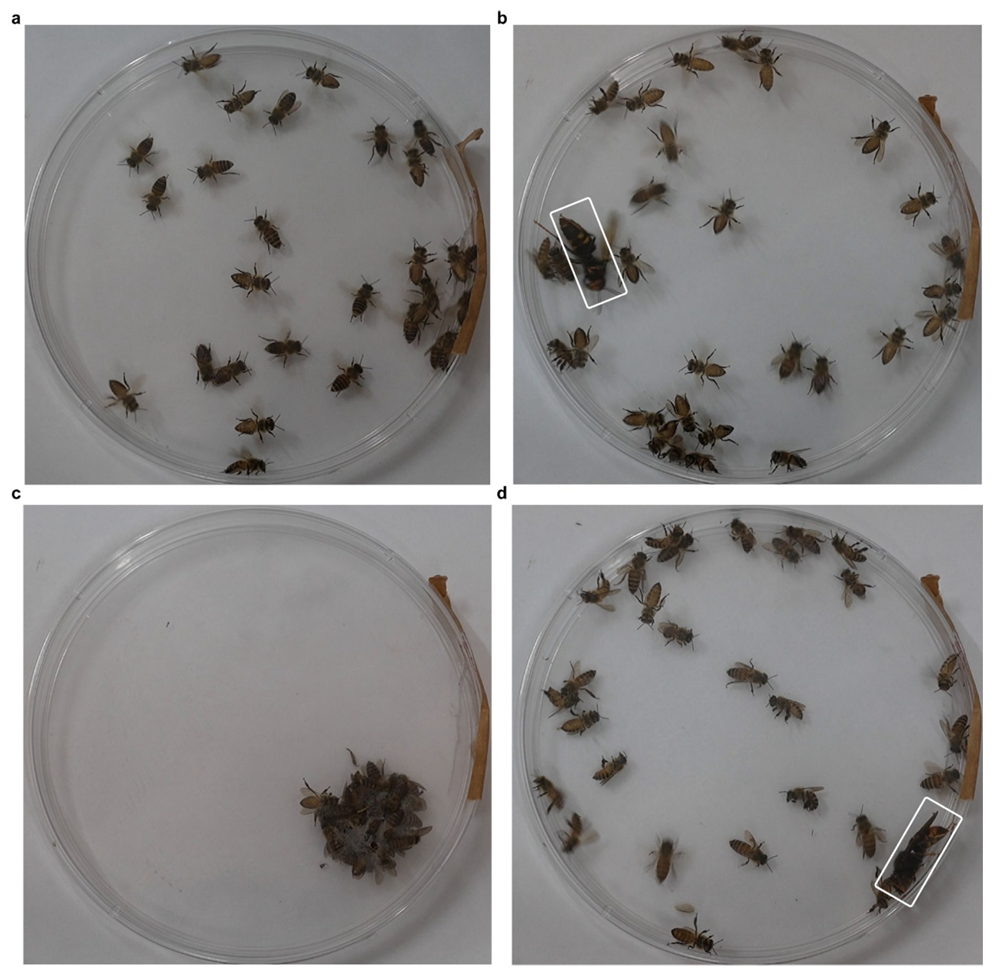
Collective behavior in biological systems often involves abrupt reorganization of group structure across time and space. The Asian honey bee (Apis cerana) defends its colonies against predatory hornets (Vespa velutina) by forming defensive “bee balls”, in which bees rapidly aggregate around the attacker to form a dense defensive cluster. However, the structural dynamics underlying this process remain poorly understood. In this study, we investigate bee-ball formation using topological analysis across time and filtration scales, together with interaction network analyses. Our results show that bee-ball formation exhibits two identifiable state transitions, indicating a shift from a dispersed state to an aggregated state and then back to a dispersed state. Network analysis further reveals strong size dependence, with larger swarms showing stronger connectivity and a greater ability to form and maintain stable bee balls. These findings provide a quantitative framework for understanding how collective defence emerges through structural reorganization and for analyzing state transitions and network dynamics in biological collective systems.
Feb 2026, Microchemical Journal
Tianhao Shi, Shiqi liuye, Yuqing chen, Liulin Yang*, and Xiao-Yu Cao*
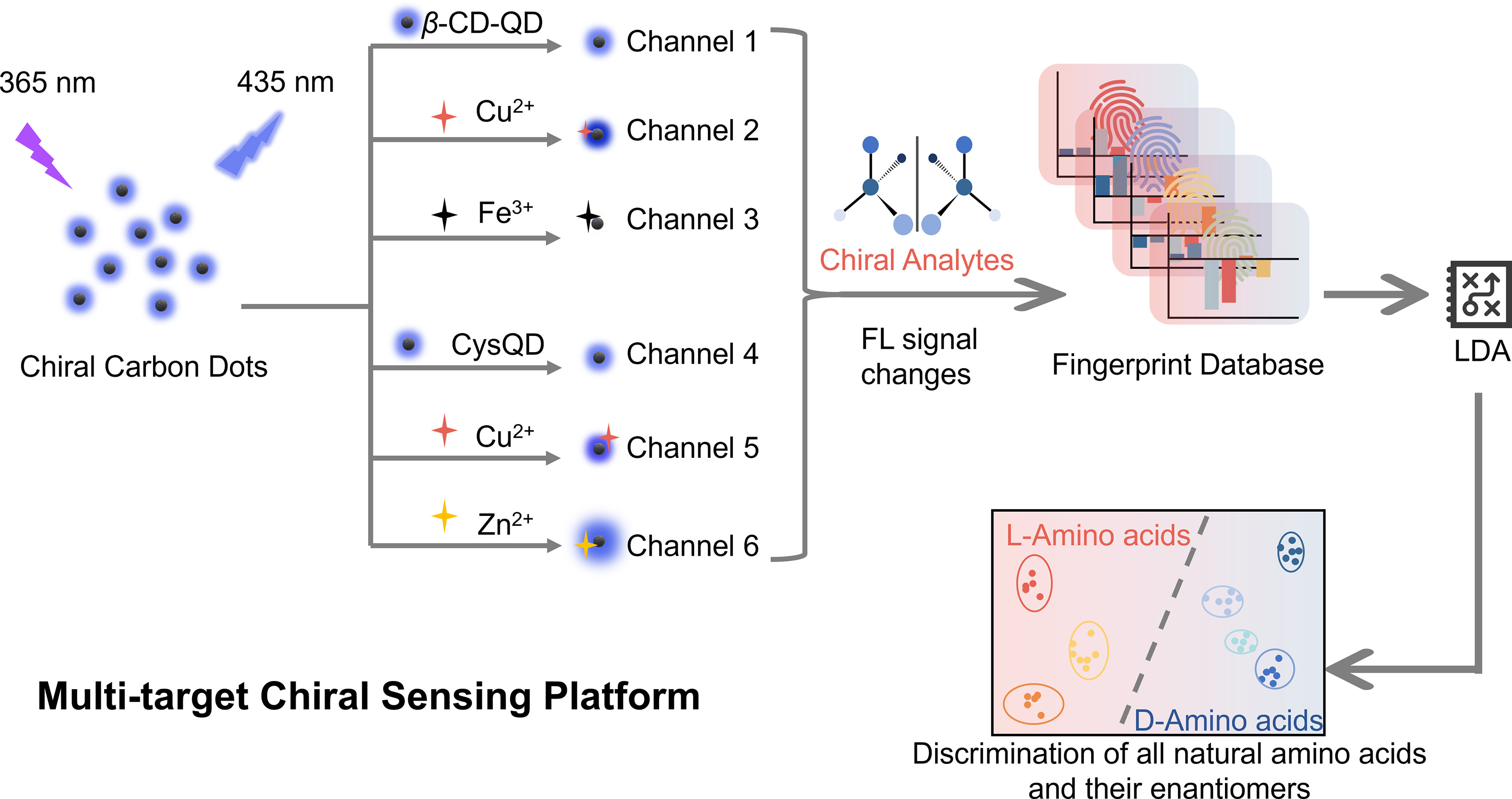
Sensitive, high-throughput, and cost-effective analysis of multiplex chiral analytes in complex biological environments remains a challenge. In this study, we constructed a fluorescent sensor array based on chiral carbon dots (CCDs) and metal ions, realizing rapid, multi-target detection of all D- and L-amino acids, as well as their mixtures in artificial saliva. The incorporation of CCDs endowed the array with high chiral recognition capability, while a designable signal-gain strategy using metal ions greatly enhanced sensitivity. Three metal ions (Cu2+, Fe3+, and Zn2+) were employed to modulate the fluorescence of two CCDs through quenching or enhancement. Upon amino acid addition, fluorescence intensities across six channels were either restored or further quenched, owing to the competitive interactions among amino acids, metal ions, and CCDs. This 6-channel array successfully identified all natural amino acids and their enantiomers within 30 s. Furthermore, it enabled quantitative analysis and discrimination of mixtures containing different ratios of D-amino acids in saliva, achieving a detection limit for D-Ala of 1.08 μmol/L—lower than the reported threshold indicative of gastric cancer. This strategy extends the application of carbon dots in multi-target chiral discrimination for rapid in vitro detection.
